A report on the “Extremely Dangerous Creatures Exhibition: Science Takes on the True Power of Living Things” (National Museum of Nature and Science). This exhibition stimulates intellectual curiosity by focusing on the “special moves” of dangerous creatures, such as overwhelming power and deadly venom.

National Museum of Nature and Science
Exhibition view

In recent years, so-called “battle encyclopedias,” which introduce and discuss the strengths of animals, dinosaurs, and mythical creatures in a battle format, have become very popular. “What is the strongest animal in the world?” “It’s the African elephant, obviously.” “No, after all, the hippo is strong.” Such discussions are a fun topic that can get both curious children and adults excited.

Immense power, sharp fangs, deadly venom, electric shocks. The astonishing abilities of dangerous creatures that humans cannot match. These are abilities that can be called “ultimate techniques” that they have acquired through evolution to hunt prey and defend themselves.

Focusing on such deadly techniques, the special exhibition “Super Dangerous Creatures Exhibition: Science Takes on the True Power of Living Things,” which explores everything from the astonishing ecology of dangerous creatures to the hidden dangers of familiar organisms from a scientific perspective, is currently being held at the National Museum of Nature and Science in Ueno, Tokyo. It may offer a new perspective on the debate surrounding “the strongest.” (The exhibition runs until June 14, 2026)

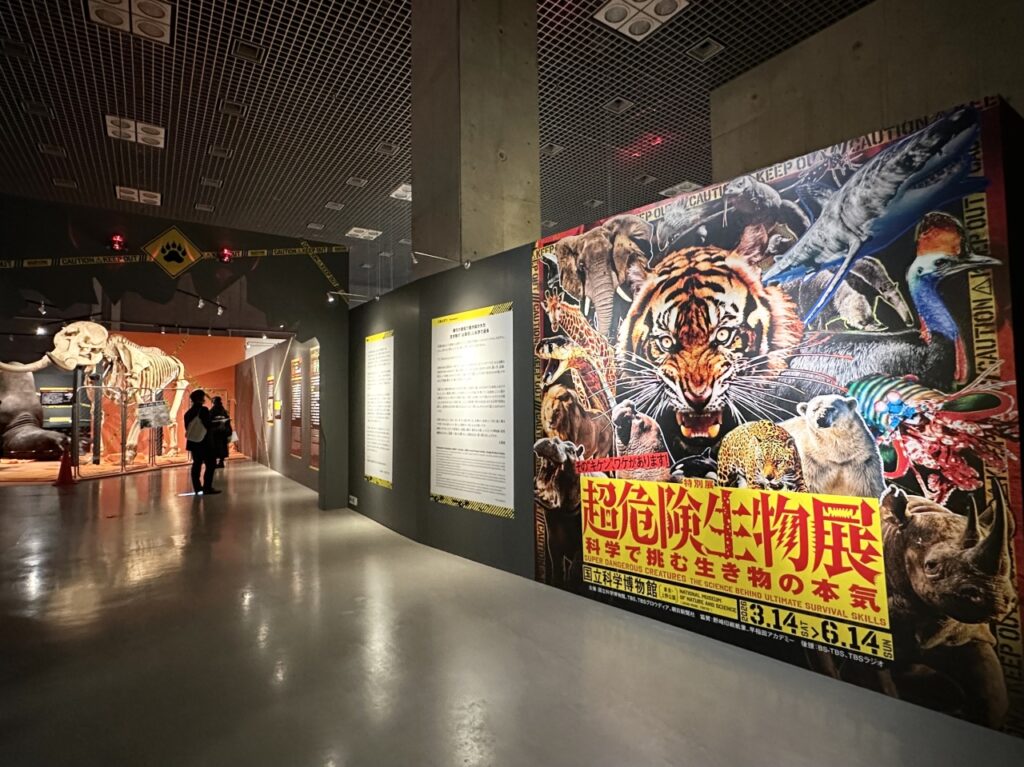
Venue entrance
Exhibition view
Exhibition view

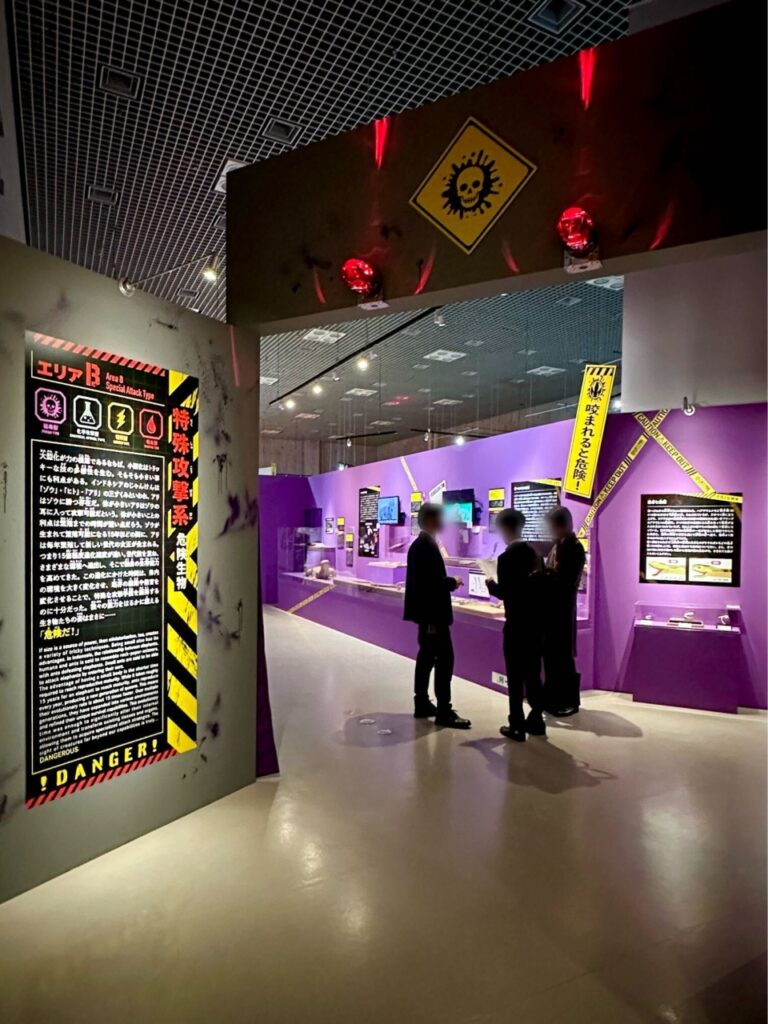
The venue’s design concept is a “forbidden laboratory exploring the astonishing abilities of dangerous creatures.” Instead of using existing taxonomic groups, dangerous creatures are classified into eight types based on their signature moves. They are presented using a variety of methods, including valuable specimens, sophisticated CGI, educational models, and impressive documentary footage.

■Exhibition composition
Area A: “Dangerous creatures that use melee attacks”
Lab 1. Power Fighter Type
Lab 2. Killer bite type
Lab 3. Armed Type
Lab 4. Large Swarm Type

Area B: “Dangerous creatures with special attack capabilities”
Lab 5. Highly venomous type
Lab 6. Chemical Attack Type
Lab 7. Electric Shock Type
Lab 8. Vampire type

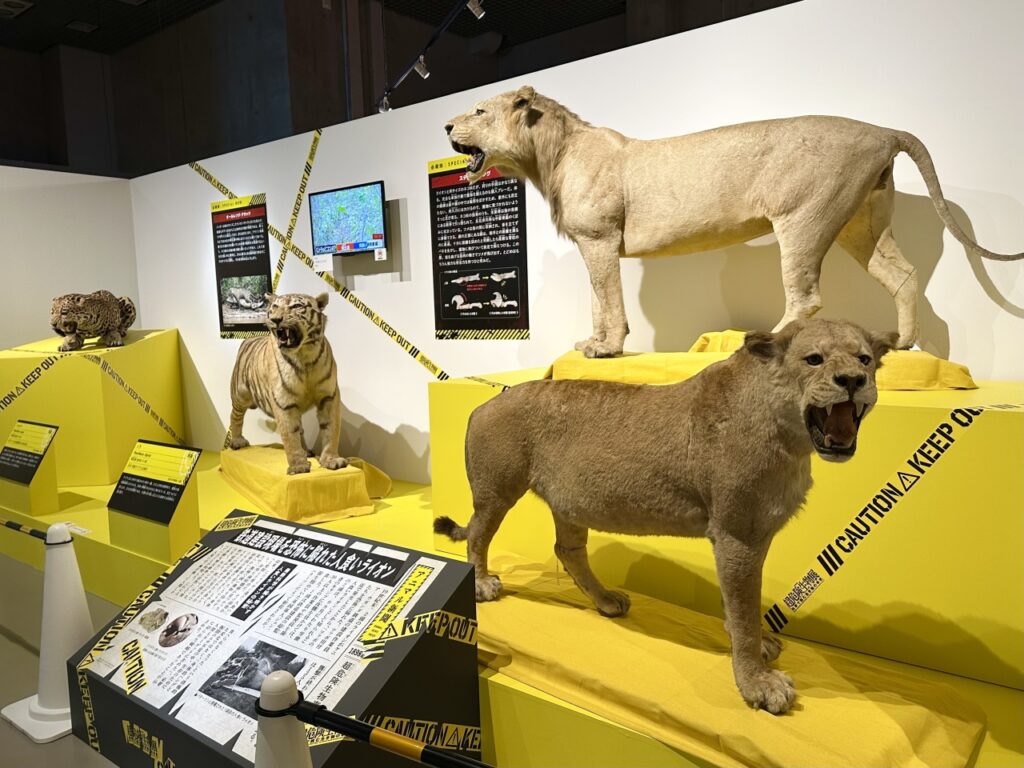
The dangerous creatures research institute has an underground atmosphere, with “KEEP OUT” tape stretched all over it.

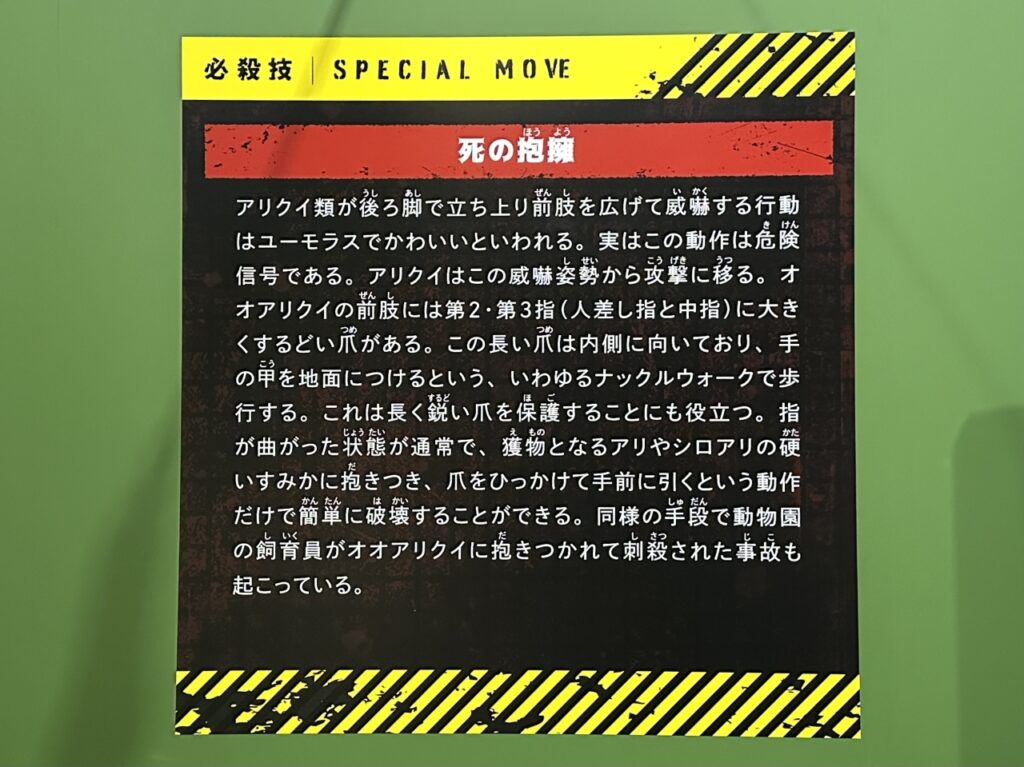
Basically, each exhibit showcases one special move for each species, and apparently, the names of each move were created specifically for this exhibition by the curators in charge of each field. From cool move names that you’ll want to say out loud, to puns, and even some that are just too straightforward, the individuality of the curators shines through.

The giant anteater’s signature move is called “Death Embrace,” which is quite poetic.

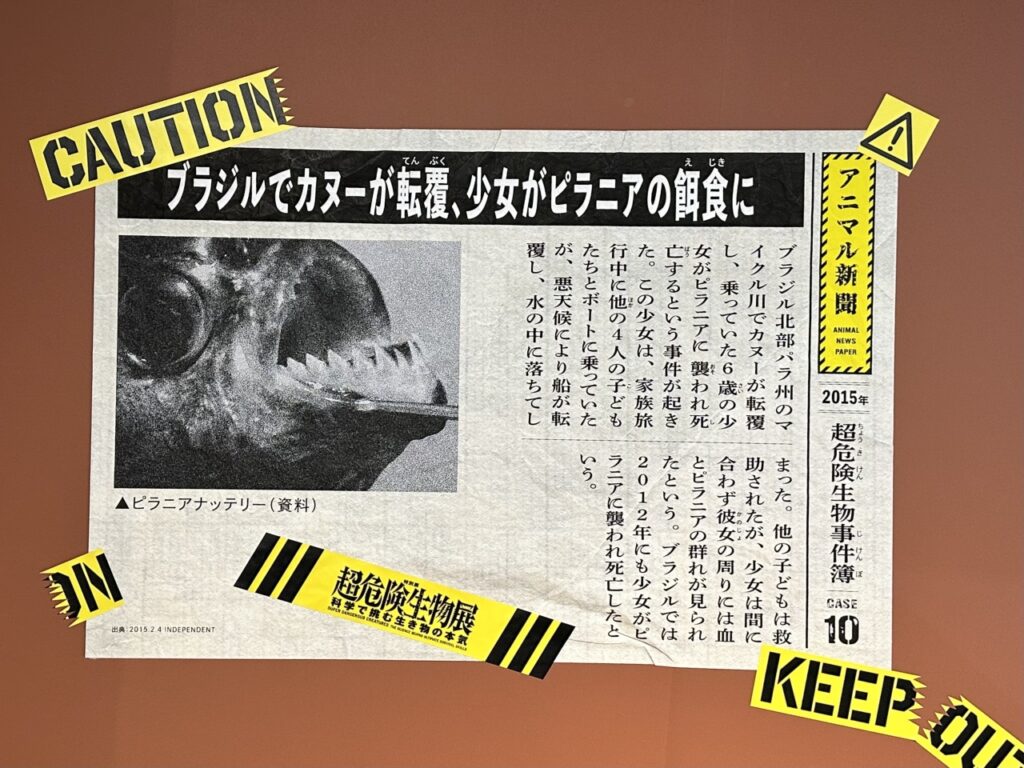
Also noteworthy are the exhibits that will appeal to children, such as “Animal Newspaper: The Case Files of Extremely Dangerous Creatures,” which presents real-life incidents involving dangerous creatures both domestically and internationally in a newspaper-style format, and card game-style icons categorized by type.

Animal Newspaper Exhibition

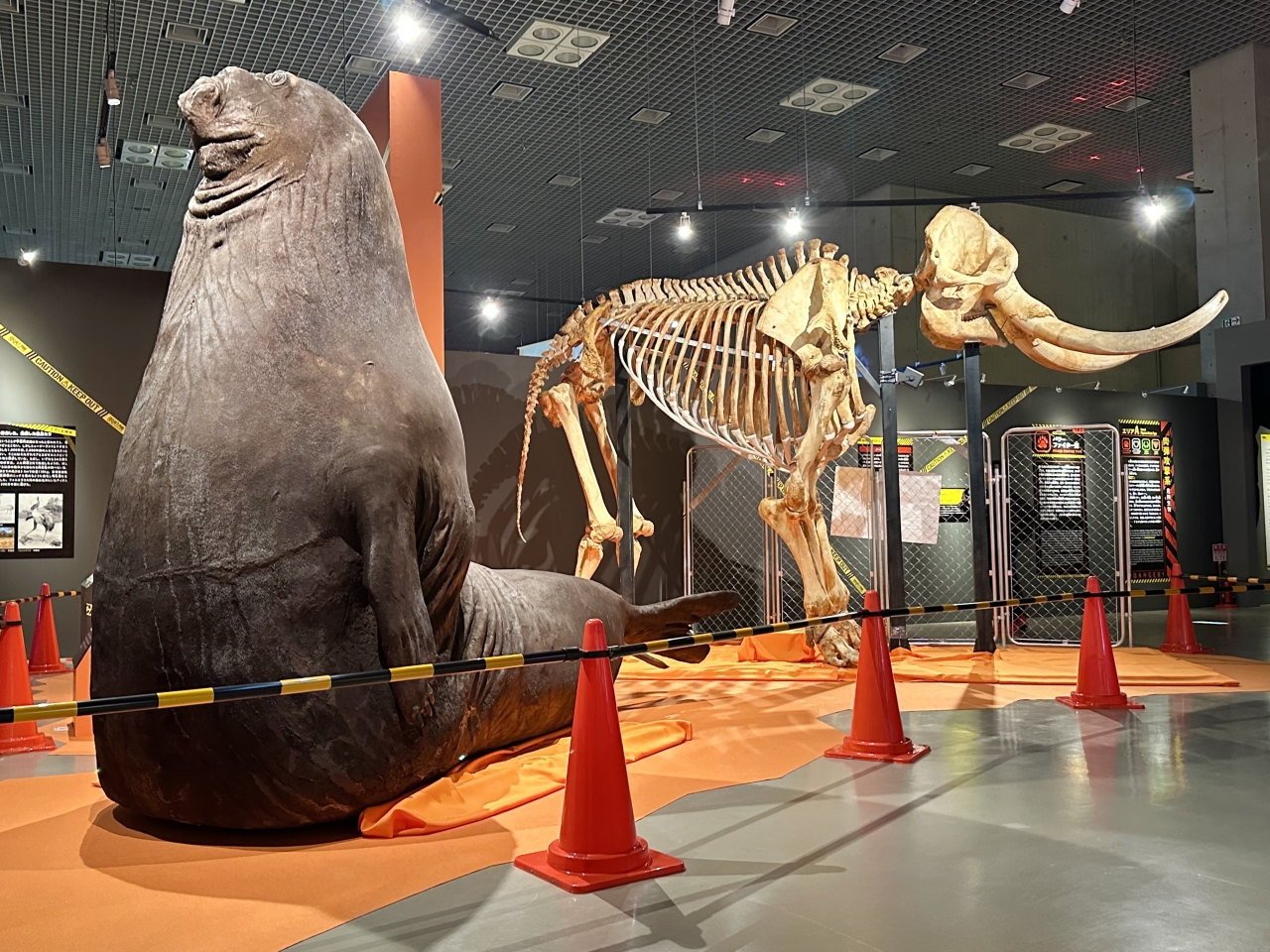
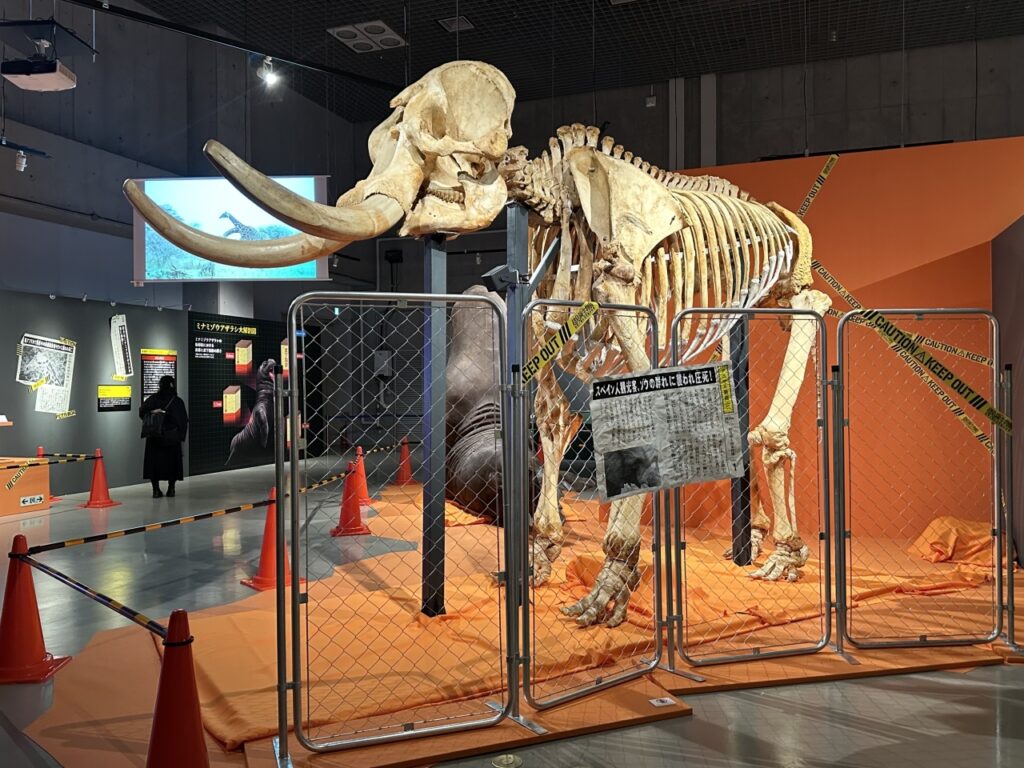
The “Power Fighter” exhibits are particularly impressive. Featuring African elephants, as well as green anacondas and cassowaries, these creatures possess overwhelming size and power that poses a formidable threat without needing any tricks.

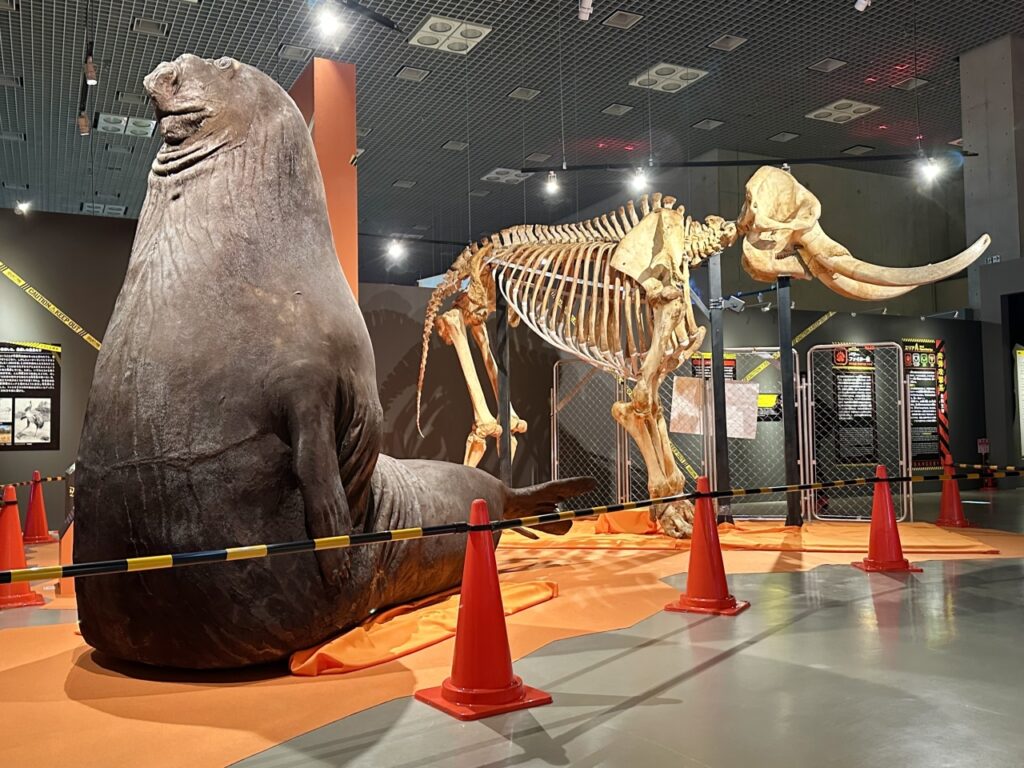
A complete skeleton specimen of a “power fighter” type African elephant (belonging to “Tamao,” who was kept at Tama Zoological Park) / Collection of the National Museum of Nature and Science

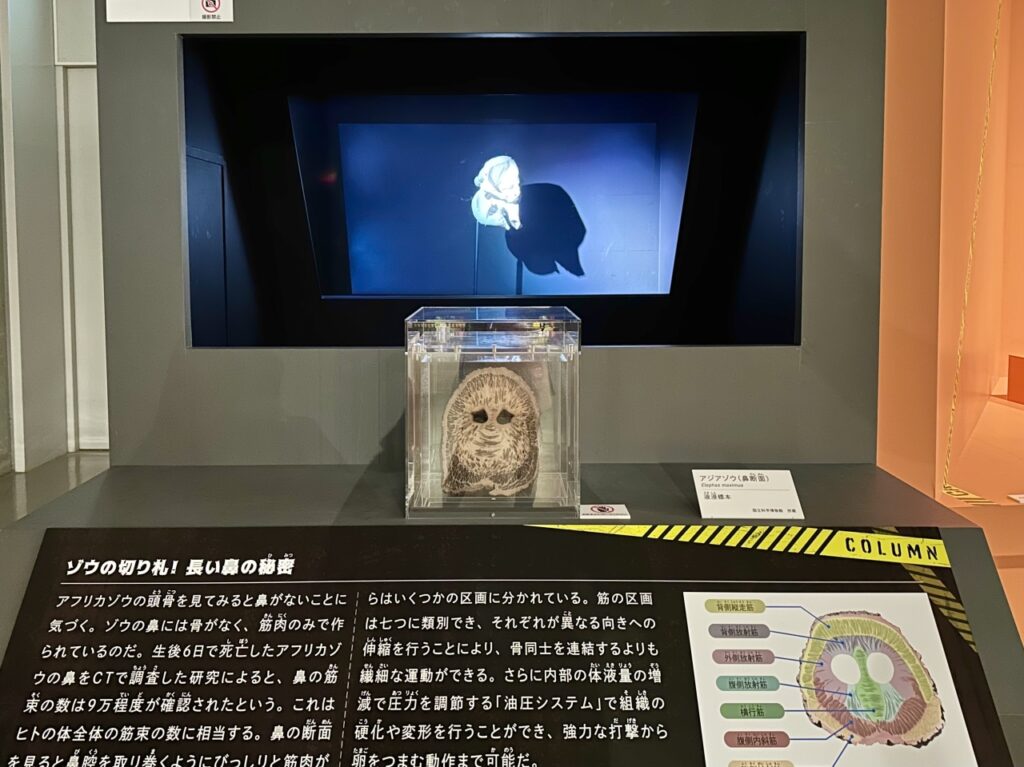
For example, African elephants can deliver a devastating blow with a simple yet powerful move called the “nose powerbomb,” which involves simply flicking their trunk. The trunk, which is key to this move, can reach 2 meters in length and weigh 150 kg, and is unique in that it has no bones and is composed entirely of muscle. It is made up of bundles of approximately 90,000 muscle fibers, equivalent to the number of fibers in a human body, which allows for complex contractions and extensions. Furthermore, it is said that the hardness and shape of the trunk can be freely changed by adjusting the pressure by changing the amount of fluid inside, similar to a hydraulic system. Therefore, they possess not only brute strength but also dexterity, such as being able to pick up a chicken egg.

Using 3D holograms, we delve into the secrets of the African elephant’s trunk, which generates incredible power.
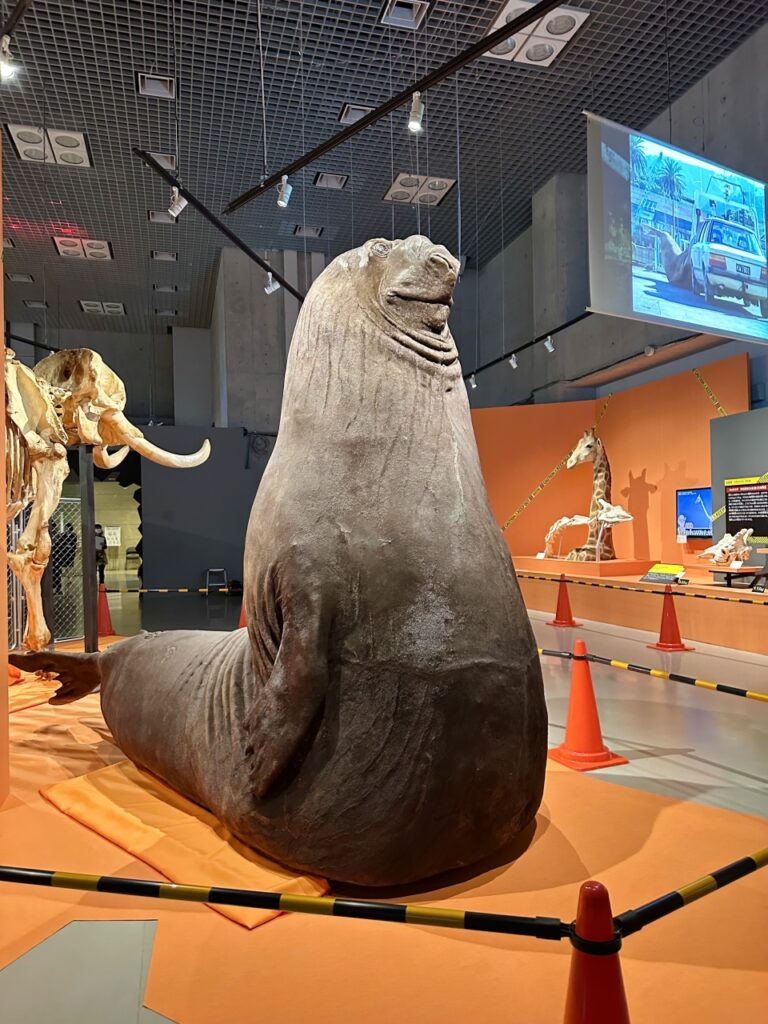
A taxidermied specimen of a “power fighter” type southern elephant seal / Collection of the National Museum of Nature and Science

The next exhibit features a massive stuffed southern elephant seal, comparable in size to an African elephant. While many people may picture seals as laid-back, round, and calming animals, male southern elephant seals boast an impressive size of 5 meters in length and weigh 3 tons.

Even when bitten by sharks or orcas, elephant seals can sometimes survive by using a thick layer of subcutaneous fat up to 10 cm thick to block the teeth and regenerate their skin, demonstrating their remarkable survival abilities. Here, they show documentary footage of a southern elephant seal that wandered into the city and tried to crush a car with its deadly “body press” move while crawling, giving you a real sense of the threat they pose.

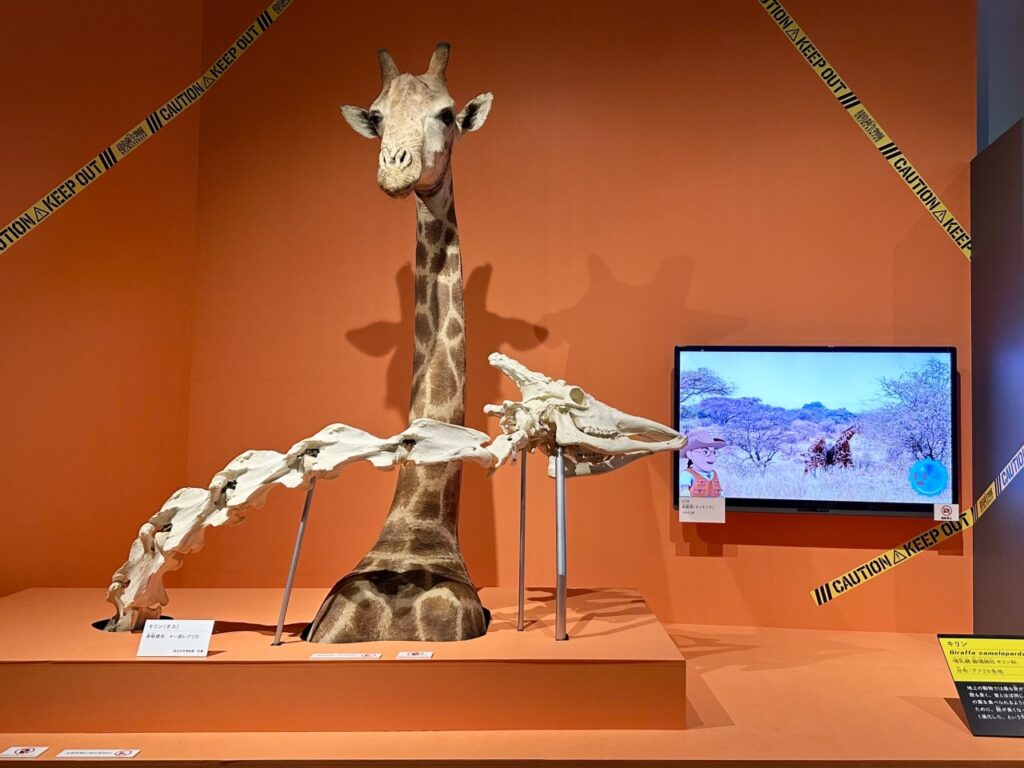
An exhibit of a “power fighter” type giraffe (stuffed neck). Although giraffes are generally thought to be gentle, their signature move, “necking,” involves whipping their necks like a whip to deliver powerful blows, making them truly power fighters.
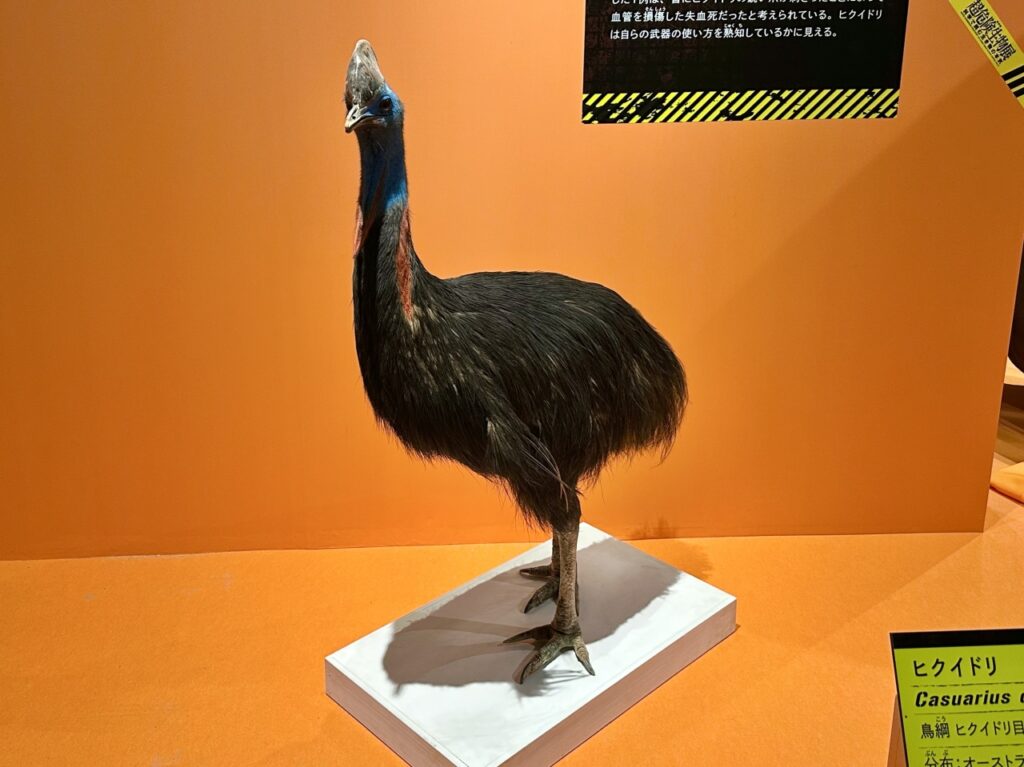
A stuffed specimen of a “power fighter” cassowary, housed at the Abiko City Bird Museum. It holds the Guinness World Record for being the “world’s most dangerous bird,” and its “spike kick,” delivered with its long, sharp, ice-pick-like claws, can shatter a watermelon in a single blow.
“Killer Bite” type exhibit

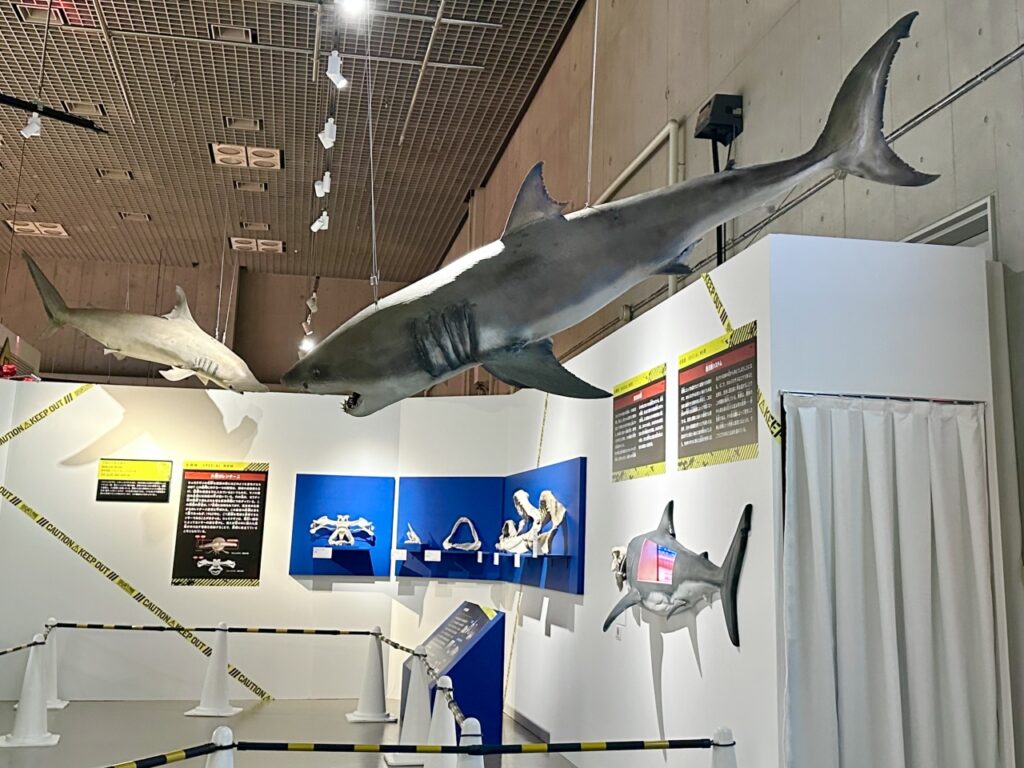
Another appealing aspect of this exhibition is that, starting with the theme “Orca vs. Great White Shark: Who is the strongest in the ocean?”, the columns displayed throughout the venue offer various pieces of information to help you make informed decisions about the topic of strength .

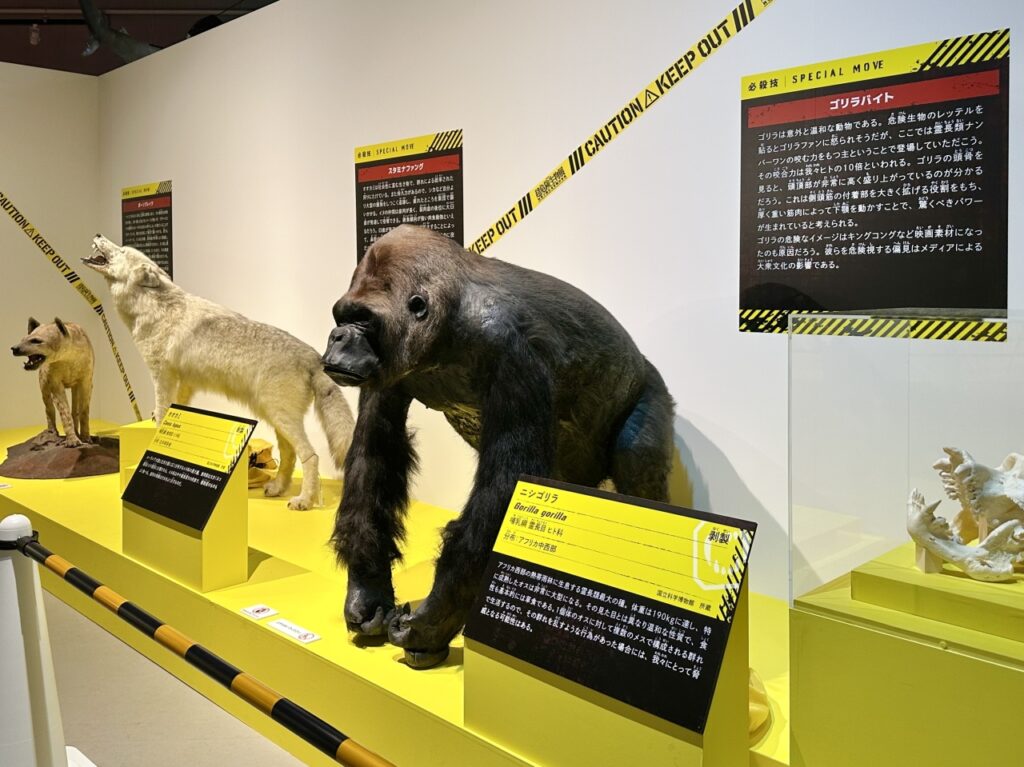
For example, in the “Killer Bite” exhibit, which features dangerous creatures that excel at biting, we explain not only the structure of teeth, which are covered with enamel, the hardest tissue in living organisms, but also the force of biting, or “occlusal force.”

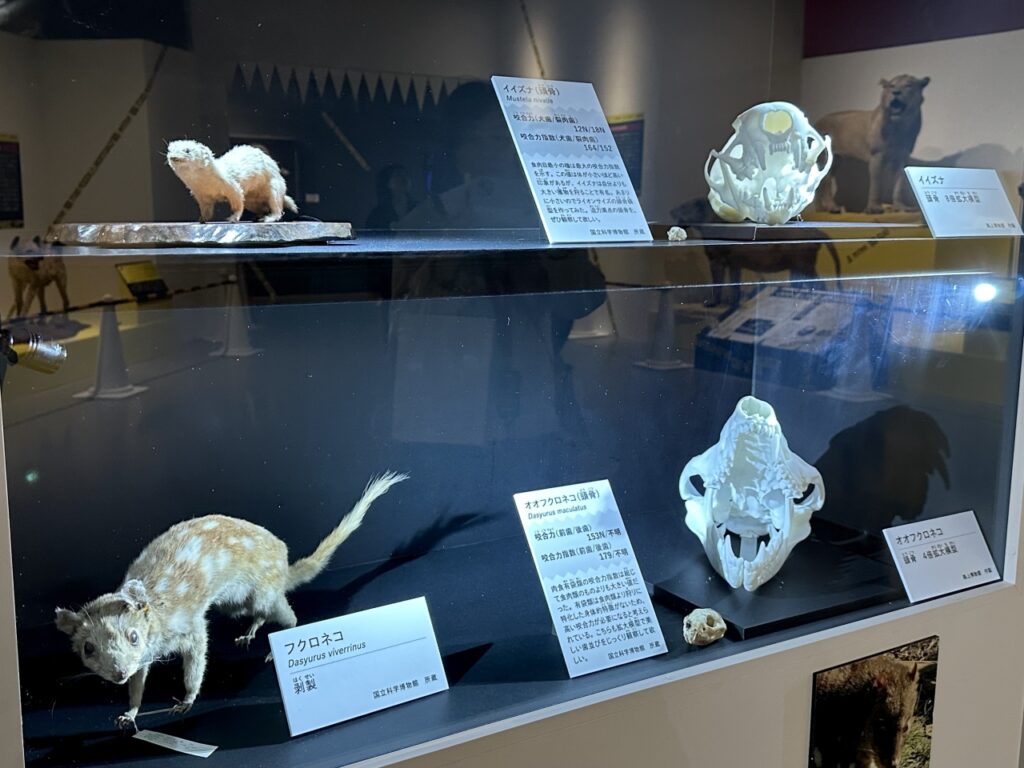
When comparing the Bite Force Quotient (BFQ), a metric used to compare relative bite force independent of body size, among carnivores, an interesting result was found: the least weasel (164), a small species of weasel weighing around 100g, significantly surpasses the lion (123) and spotted hyena (99.6). Furthermore, the giant panda (151), a carnivore that is also a herbivore, also ranks highly, demonstrating that small size or herbivorous diets should not be underestimated.

“Killer bite” type least weasel and marsupial cat on display.

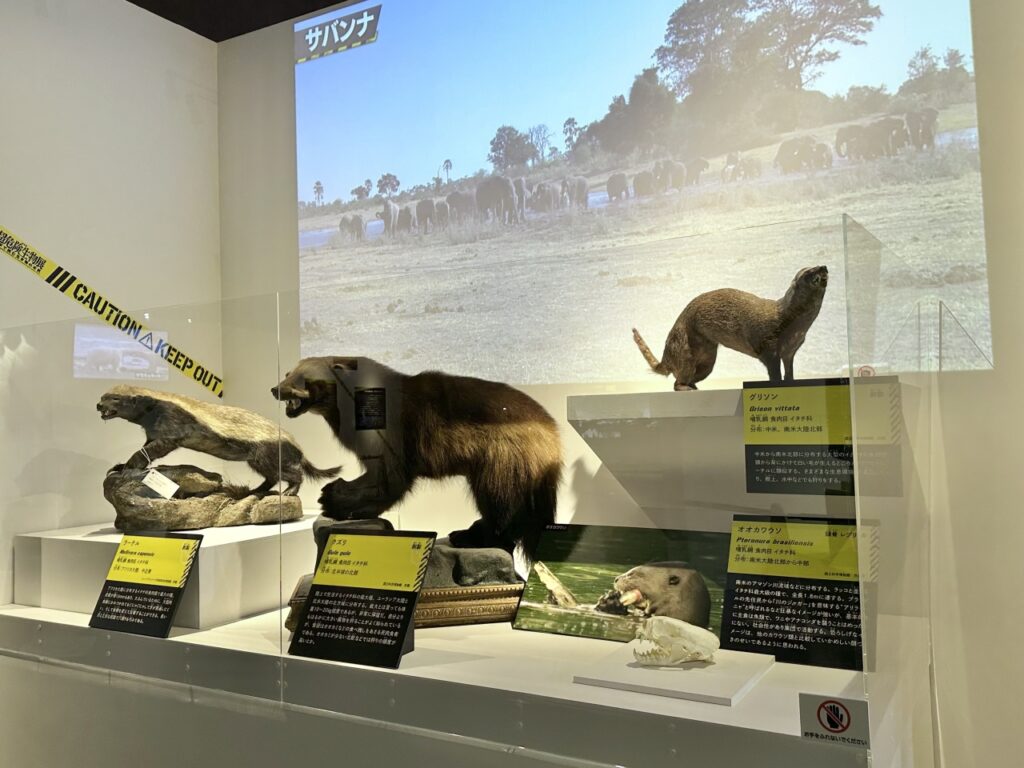
The weasel family is comprised of extremely ferocious hunters, known for using their sharp canine teeth to take down prey larger than themselves, such as least weasels and wolverines. In particular, the honey badger, the largest species of weasel found on the African continent, is said to fearlessly confront lions that weigh more than 10 times its own weight, and its fierce fighting spirit is truly remarkable.

Exhibits featuring “killer bite” type wolverines, honey badgers, and other members of the weasel family.

The honey badger’s signature move (ability) isn’t biting, but rather an “impenetrable body and anti-poison.” Surprisingly, its thick, flexible skin makes it resistant to damage from animal bites, porcupine stings, and bee stings, and it’s even resistant to the blows of venomous snakes like cobras. It can be said to be a well-balanced fighter with high levels of attack, defense, and survival ability.

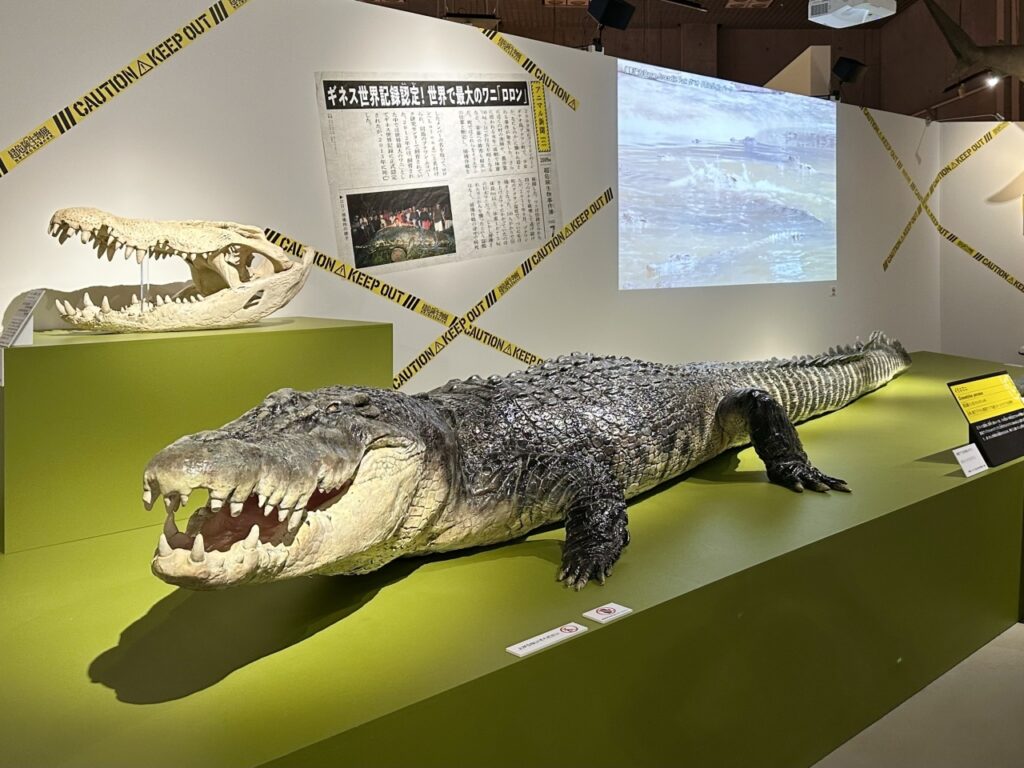
Furthermore, the “Killer Bite” exhibit features the first-ever public display in Japan of a life-size replica of the world’s largest saltwater crocodile, nicknamed “Roron,” which measures over 6 meters in length .

A life-size replica of a “killer bite” type of saltwater crocodile (Lorong) / The original specimen is housed in the National Museum of Natural History of the Philippines.

Saltwater crocodiles, sometimes called “man-eating crocodiles” due to the numerous reported fatalities, are a popular subject of interest. Among them, Lolong holds the Guinness World Record for the “largest crocodile in captivity,” with an astonishing length of 6.17m and a weight of 1,075kg. A life-size replica of Lolong, faithfully reproduced from scans of its data taken in the Philippines, is on display at the venue. Its impressive size makes the story of how it took 100 people to pull it out of the sea quite believable. Another highlight is the video explanation of the “death roll,” where the crocodile bites its prey and twists its massive body underwater to tear it apart.

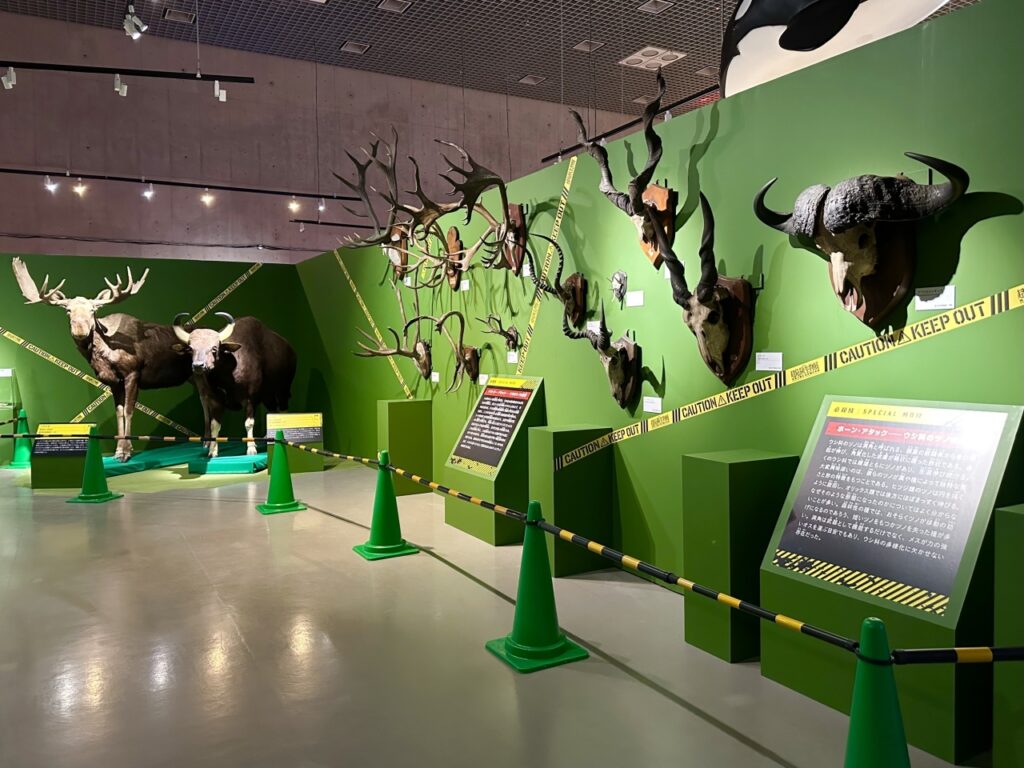
This is an exhibit featuring “armed” animals. The sight of the stylish horns of bovine and deer lined up is spectacular.
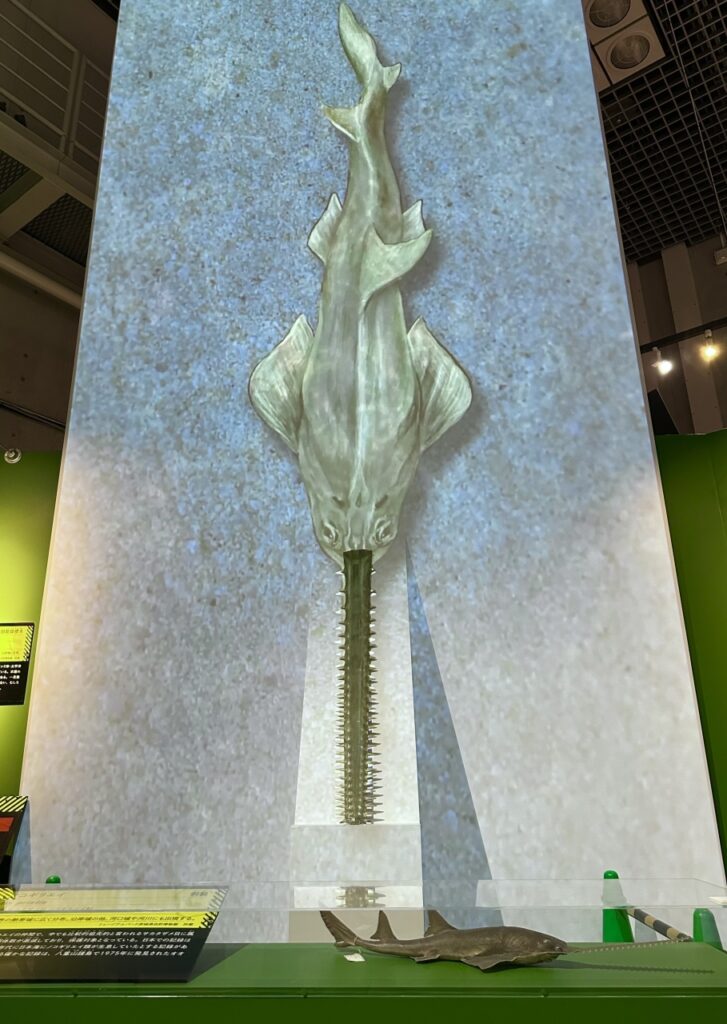
An exhibit of an “armed” giant sawfish. The unusual “giant saw” that it swings around at lightning speed during hunting is truly impressive.

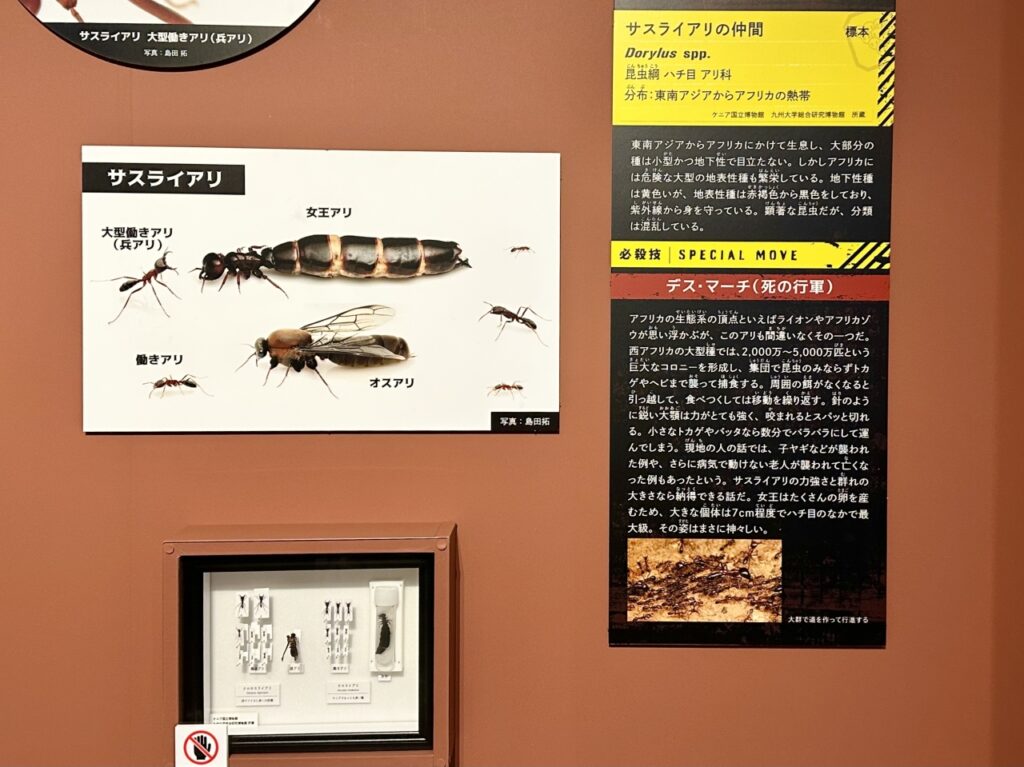
Among the exhibits featuring “swarming” creatures that pose a threat in groups, such as grasshoppers and piranhas, the army ant section is a must-see.

The army ant, which inhabits Southeast Asia and Africa, is known for its ecology of swarming in the tens of millions of individuals, devouring surrounding prey before moving on. It’s not just small lizards and grasshoppers that are attacked and killed; there have been reports of attacks on baby goats and even elderly people who are unable to move due to illness. The sheer power of their predatory abilities is enough to send chills down your spine.

Exhibit of “large-group” army ants

The queen ant, the center of the colony, has long been considered an elusive and almost mythical creature, difficult to even confirm despite years of research by researchers both in Japan and abroad. However, Munetoshi Maruyama, associate professor at the Kyushu University Museum and one of the exhibition’s supervisors, and Taku Shimada, an insect explorer and photographer, conducted research in the Republic of Kenya. During filming for the TBS program “Crazy Journey,” they successfully encountered and photographed a queen ant. One of these precious queen ant specimens is on display in Japan for the first time at the venue.

Area B in the second half, “Special Attack Dangerous Creatures,” is exciting because of the variety of tricky special moves.

The exhibition begins with a “highly venomous” section analyzing the toxins of diverse creatures such as wasps, baby monitor lizards, and blue-ringed octopuses. This is followed by a “chemical attack” section featuring bizarre special moves such as the striped skunk’s powerful stinging liquid, 100°C high-temperature gas, and self-destructive defenses. The “electric shock” section explores the power generation mechanisms of creatures like electric eels, which can generate voltages of up to 850 volts. Finally, the “blood-sucking” section focuses on blood-sucking creatures such as vampire bats and ticks, and also touches upon the dangers of infectious diseases.

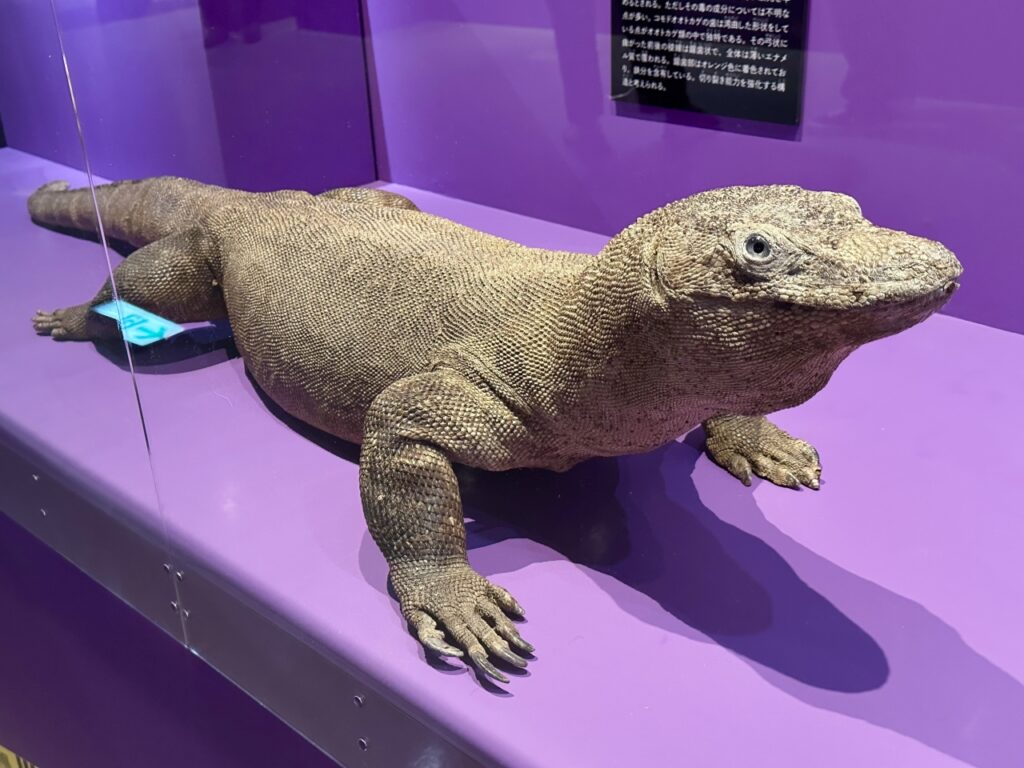
Taxidermied specimen of a highly venomous juvenile monitor lizard / Collection of the National Museum of Nature and Science

Area B features many creatures with visuals that may evoke a sense of physiological revulsion, such as tarantulas and giant centipedes, so those who are squeamish should be cautious. If you’re okay with that, please do take the time to observe their appearances in detail.

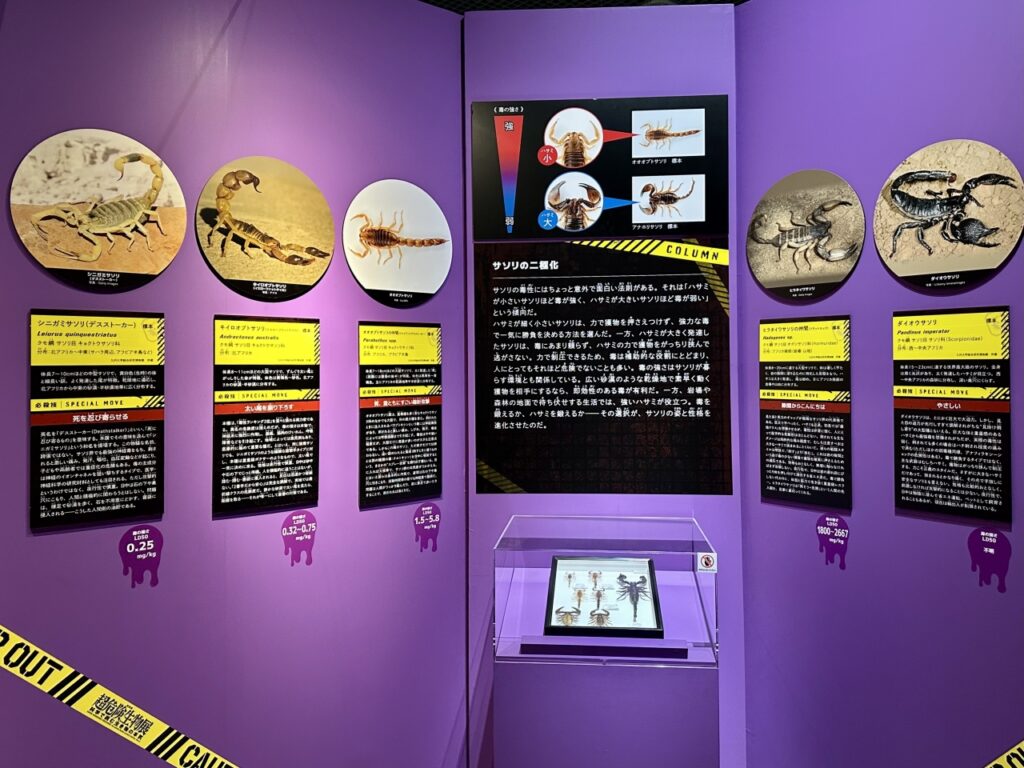
In the section dedicated to scorpions, a prime example of “highly venomous” scorpions, you’ll find the Deathstalker (meaning “the one that creeps towards death”), a medium-sized, slender scorpion with one of the most potent neurotoxins in the scorpion world, alongside the Emperor Scorpion, whose venom is surprisingly weak despite its imposing appearance, often resulting in pain comparable to a bee sting. An interesting point about scorpion venom is the tendency that “the smaller the claws, the stronger the venom, and conversely, the larger the claws, the weaker the venom,” which clearly demonstrates the fact that “the level of danger is not always what it seems.”

Exhibit of “highly venomous” scorpions
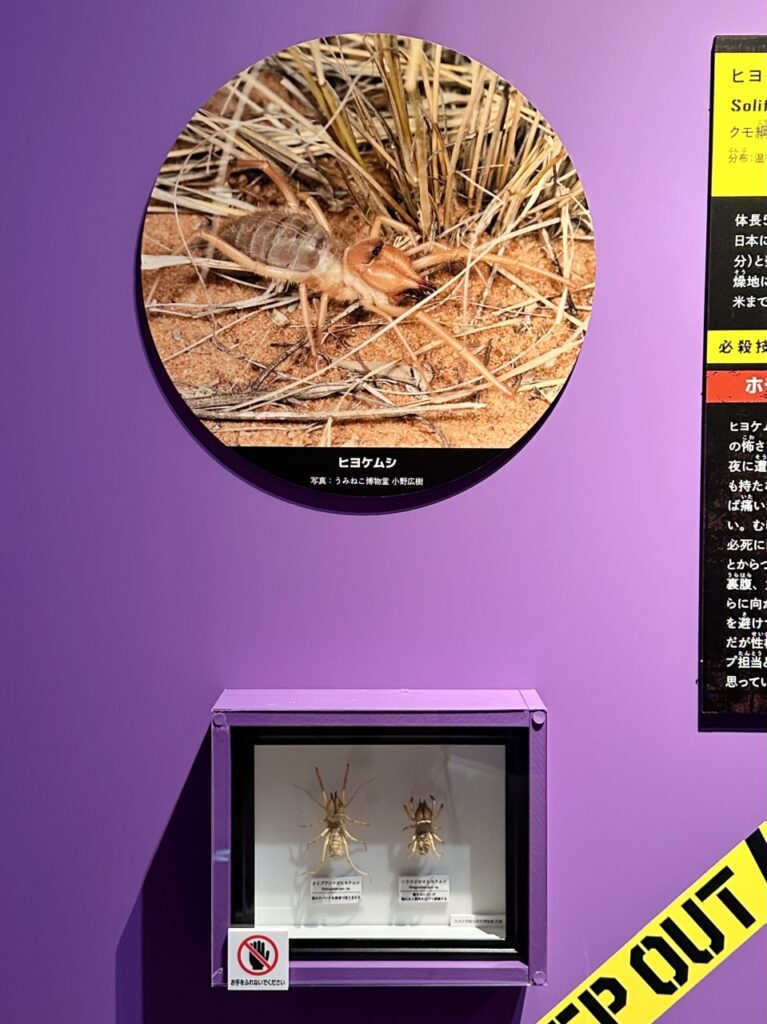
Exhibit of “highly venomous” sun spiders

Speaking of creatures that are all show and no substance, the “highly venomous” sun spider, described as “one of the most frightening in the arthropod kingdom based on first impressions alone,” is a prime example. Its enormous chelicerae are impressive, but it poses no real threat beyond that. Although it may appear to charge towards humans, it is actually just seeking shade to escape the sun, which it dislikes, and is quite timid. It possesses neither venom nor a venomous stinger, so it’s a mystery why it was included in this exhibition, but that’s part of its charm. Its “dangerousness” based on its appearance is certainly on par with the main attraction.

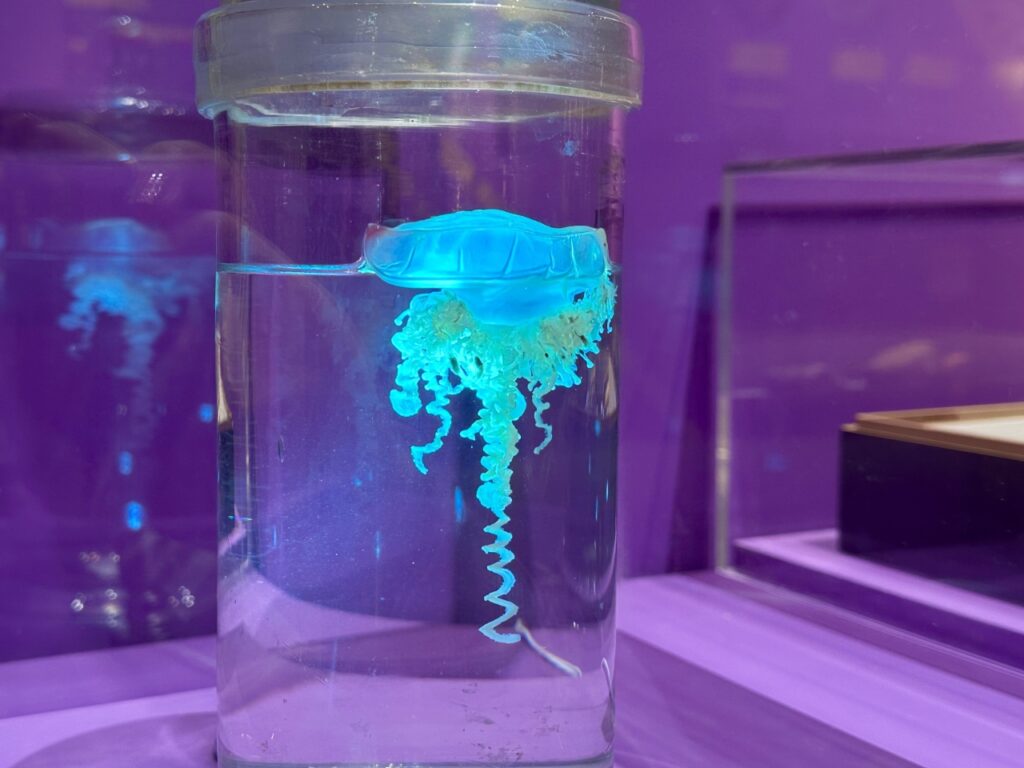
A liquid-preserved specimen of the highly venomous Portuguese man-of-war, owned by the Enoshima Aquarium. In Japan, they appear around springtime. Within milliseconds of contact with the stinger, the stinger extends and injects venom that causes convulsions and sharp pain.
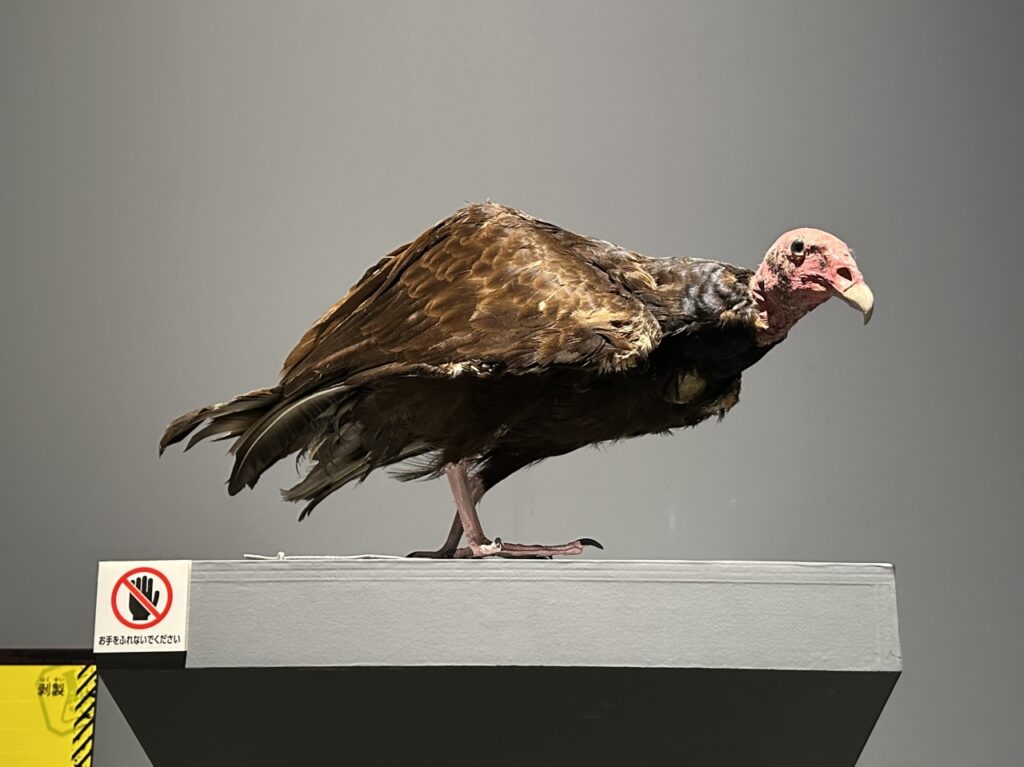
A stuffed specimen of a “scientific attack” type of turtle vulture / National Museum of Nature and Science collection. They launch a very unpleasant attack by vomiting undigested food (so-called “vomit”) from their stomachs.

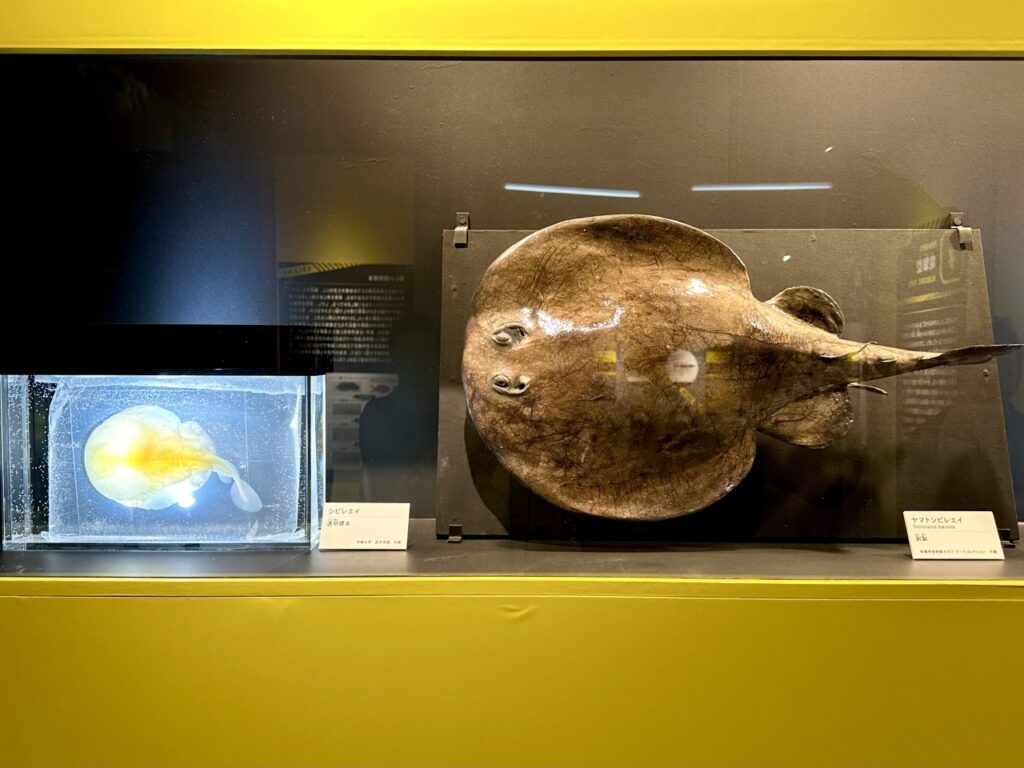
Another highlight is the use of transparent specimens created with the latest technology for the “electric shock” type of electric eel, electric catfish, and electric ray.

Transparent specimens are a method of making biological specimens transparent through chemical treatment, allowing observation of internal structures without dissection. Conventional methods involved dissolving muscles and internal organs with strong chemicals, making it difficult to observe structures other than bone. However, in recent years, clearing techniques that allow observation of cells and genes within specimens without using strong chemicals have been developed one after another. This exhibition also uses an improved version of the CUBIC method, one of these techniques, making it possible to observe the structure of power-generating organs, which were previously difficult to visualize, in three dimensions.

An exhibit of the “electric shock” electric ray. It has a pair of leaf-shaped power-generating organs on the left and right sides of the front half of its body, and there are apparently instances where it has repelled even great white sharks with electric attacks.
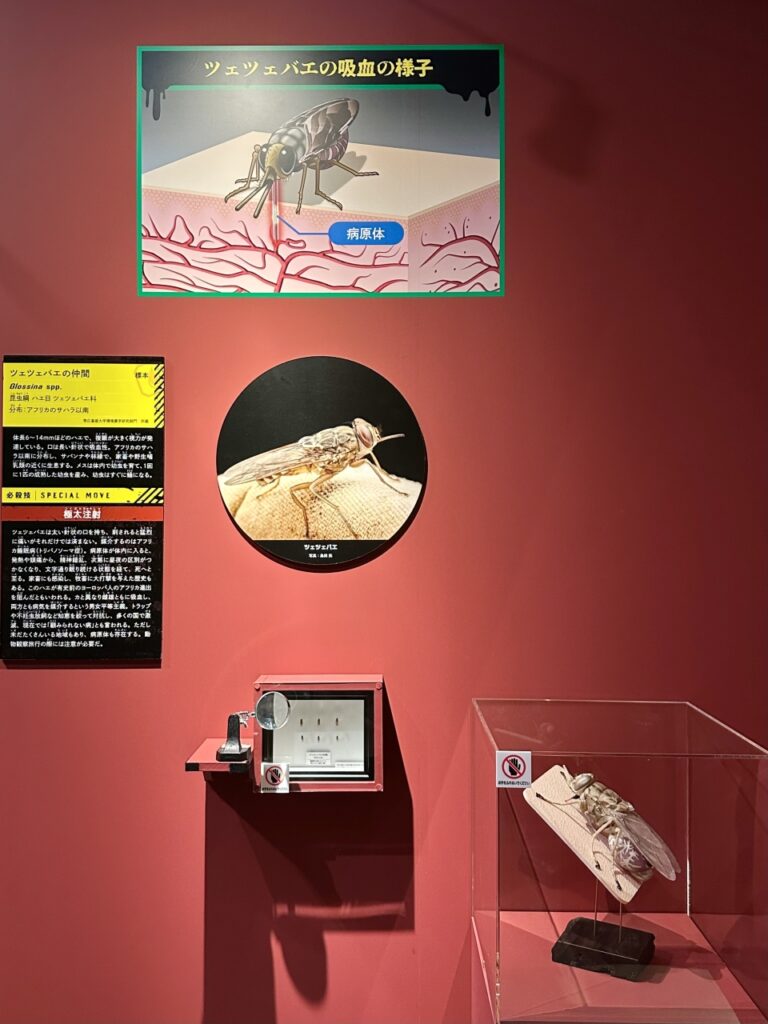
An exhibit featuring the “blood-sucking” tsetse fly. Not only does it cause excruciating pain through blood-sucking, but it also transmits African sleeping sickness, which can lead to fever, headache, mental confusion, coma, and eventually death…

This exhibition focuses on the deadly techniques of living creatures, aiming to unravel their amazing ecology and the hidden dangers of familiar organisms from a scientific perspective. However, reading the comments made by Shinichiro Kawada of the Department of Zoology at the National Museum of Nature and Science, who serves as the overall supervisor of the exhibition, it seems that behind the planning is a desire to convey the importance of “fearing correctly” based on scientific understanding.

Kawada warns against the mass media that sensationalizes the uncertain dangers of dangerous creatures, and against modern society surrounded by the internet overflowing with fake images and videos. Humans are creatures that feel not only fear but also admiration for those who possess abilities they lack, and they want to know more about them, imitate them, and surpass them. This thirst for knowledge has greatly driven the development of science, from anatomy to cutting-edge biochemistry and genetics. Furthermore, he emphasizes that the abilities of dangerous creatures are a “treasure trove of scientific knowledge,” and that much of it can be used for materials and technologies necessary for our lives.

As you explore this exhibition, you will come to realize that the knowledge needed to “fear appropriately” is a survival strategy for humanity that will lead to a better tomorrow.

Akira Kawashima

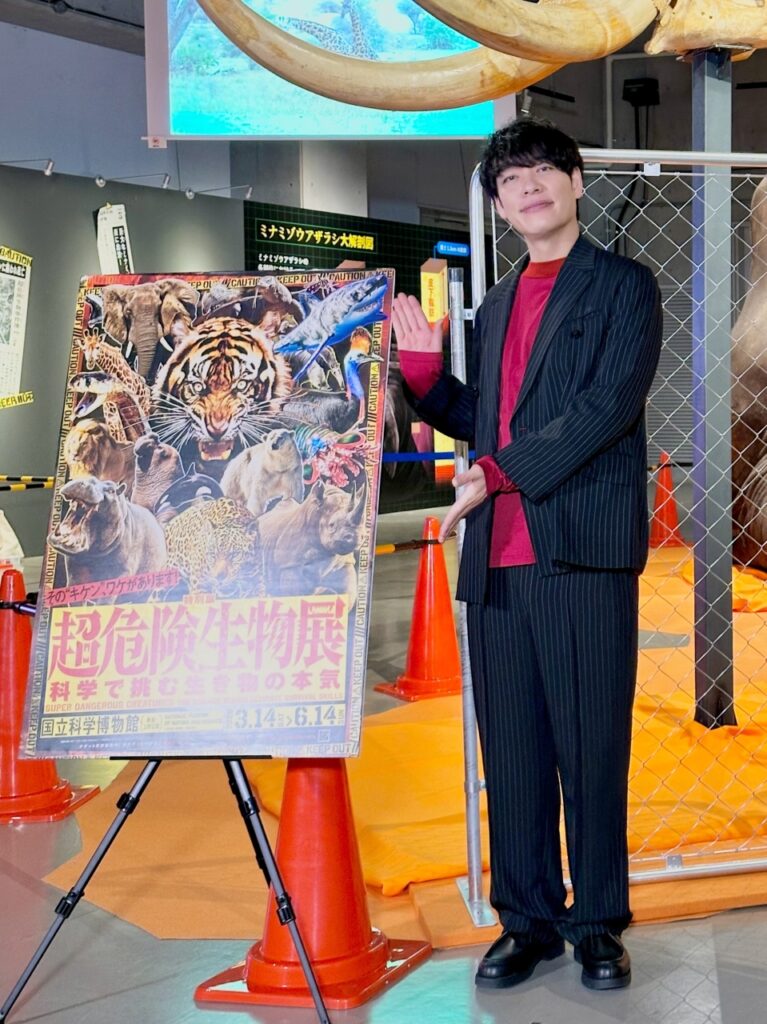
At the press preview held prior to the exhibition, Akira Kawashima of the comedy duo Kirin, who serves as the exhibition’s ambassador and audio guide narrator, made an appearance.

Regarding his impressions of the exhibition, he commented, “There are many globally valuable materials, and the exhibition unfolds in a laboratory-like world in each area, so it felt like an attraction. As I went further in, I became more immersed, and I felt like I was part of the research team.” He said that the most noteworthy dangerous animal was the giraffe, and he said, “They are herbivores, and judging from their eyes, I thought they were gentle and cute, but when I saw the video, I learned that they can fight with necking, which is powerful enough to kill a person with their own neck. I felt bad for casually saying, ‘It’s a giraffe’,” which drew laughter from the audience.

Finally, they promoted the exhibition as follows:
“There was an exhibit showing that the weaker the scorpion’s venom, the larger its claws. It’s a lesson in how the weaker you are, the more likely you are to put on a brave face and pick a fight—a trait common to humans. After seeing the exhibit, you can reconsider what your own strengths are. You might find that it’s a compassionate heart, or the kindness to prioritize others—a strength unique to humans. I think it’s an exhibition where you can make such wonderful discoveries.”

The special exhibition “Exhibition of Extremely Dangerous Creatures: Science Takes on the Serious Challenges of Living Things” will run until June 14, 2026.

Special Exhibition “Exhibition of Extremely Dangerous Creatures: Science Takes on the Serious Challenges of Living Things” Overview

venue National Museum of Nature and Science
Exhibition period March 14th (Sat) – June 14th (Sun), 2026
Opening hours 9:00 AM – 5:00 PM (Last entry at 4:30 PM)
Open at night From April 25th (Sat) to May 6th (Wed, holiday), the museum will be open until 6:00 PM (last entry at 5:30 PM).
Closed days Monday, May 7th (Thursday)
*However, the museum will be open on April 27th (Monday), May 4th (Monday/National Holiday), and June 8th (Monday).
Price (tax included) General admission/University students: 2,300 yen; Elementary/Junior high/High school students: 600 yen (Tickets available on the day)
Organizer National Museum of Nature and Science, TBS, TBS Growdia, Asahi Shimbun
inquiry 050-5541-8600 (Hello Dial), 03-5814-9898 (FAX)
Official website of the operator https://chokikenseibutsuten.jp/

*Please note that the exhibition period, opening hours, and closing days may be subject to change.
*Please note that this information may not be up-to-date. For details, please check the exhibition’s official website.


Article provided by: Cocosil Ueno


View other reports

Confirmed for Autumn 2026! The National Museum of Nature and Science presents its first-ever special exhibition exploring “the sexuality of living things”: Special Exhibition “The Sexuality of Living Things”

National Museum of Nature and Science

Date: October 31, 2026 (Sat) – February 21, 2027 (Sun)
Venue: National Museum of Nature and Science (Ueno Park, Tokyo)

The National Museum of Nature and Science (Ueno Park, Tokyo) will be holding a special exhibition, "The Sexuality of Living Things," starting October 31, 2026 (Saturday). This exhibition is the first at the National Museum of Nature and Science to focus on the theme of "sexuality," and will explore the diverse forms and mechanisms of sexuality in living things.
There are many things in the world that seem obvious but are actually difficult to explain in depth. A prime example of this is "sex."
Sex is not limited to humans; it is found in all living things. Many living things have males and females, and offspring are produced when the sperm and eggs they produce are fertilized. However, the "form," "mechanism," and "behavior" of sex are surprisingly diverse and differ greatly from one living thing to another. For example, there are many cases that overturn our common sense, such as organisms whose sex changes during development, and organisms whose sex is determined by environmental factors such as temperature.
This exhibition scientifically explores the "sexual diversity" of living creatures from various perspectives, including morphology, behavior, sex determination, and parenting. It is the National Museum of Nature and Science's first special exhibition to delve into the fundamental question of what "sex" means to living things.

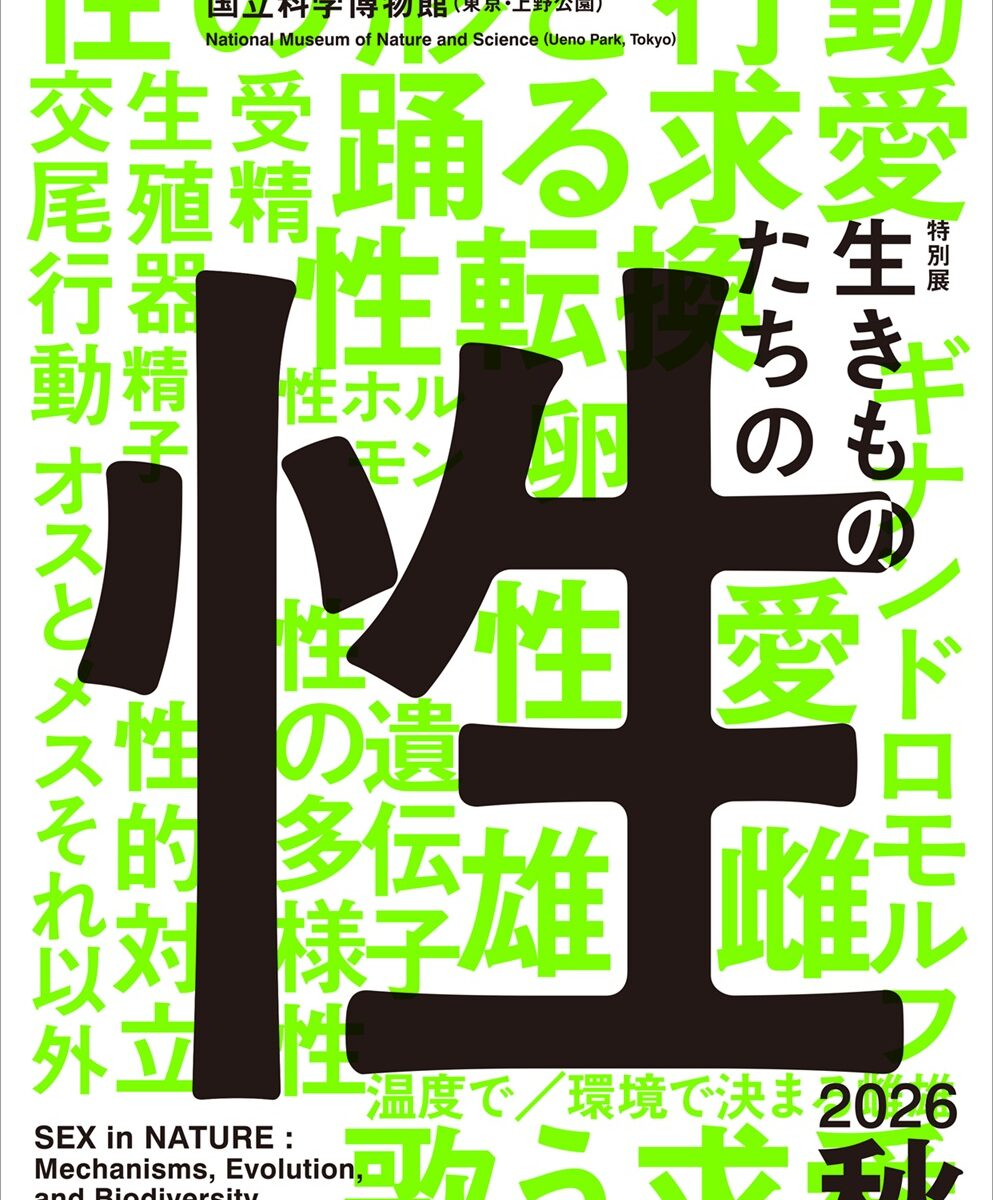
We are pleased to announce the completion of a teaser visual that represents the content of this exhibition.

The visuals are interspersed with keywords that help us understand what "sex" truly means.
The design, woven together by these keywords, visually conveys the diversity of sexuality presented in this exhibition, resulting in a striking visual.

The design of this teaser visual is
Art director Idea Oshima was in charge.

The special exhibition "The Sexuality of Living Things" will open this autumn, on Saturday, October 31st.
Please look forward to it.

[Implementation Overview]
Exhibition Title: Special Exhibition "The Sexuality of Living Things"
Date: October 31, 2026 (Sat) – February 21, 2027 (Sun)
Venue: National Museum of Nature and Science [Ueno Park, Tokyo]
(7-20 Ueno Park, Taito-ku, Tokyo 110-8718)
Organizers: National Museum of Nature and Science, Yomiuri Shimbun, Fuji Television Network
For inquiries: 050-5541-8600 (Hello Dial), 03-5814-9898 (FAX)
Official website: https://www.ikimono-sei.jp

■ Supervision
General Supervision
Chie Tsutsumi (Senior Researcher, Biodiversity Analysis and Conservation Group, Department of Botany, National Museum of Nature and Science)
Kenichi Shinoda (Director, National Museum of Nature and Science)

Supervision
Isao Nishikai (Senior Researcher, Vertebrate Research Group, Department of Zoology, National Museum of Nature and Science)
Shinichiro Kawada (Senior Researcher, Vertebrate Research Group, Department of Zoology, National Museum of Nature and Science)
Yuko Tajima (Senior Researcher, Vertebrate Research Group, Department of Zoology, National Museum of Nature and Science)
Masanori Nakae (Research Director, Vertebrate Zoology Research Group, Animal Research Department, National Museum of Nature and Science)
Natsuhiko Yoshikawa (Researcher, Vertebrate Research Group, Department of Zoology, National Museum of Nature and Science)
Hiroshi Namikawa (Research Director, Marine Invertebrate Research Group, Animal Research Department, National Museum of Nature and Science)
Utsugu Jimbo (Senior Researcher, Terrestrial Invertebrate Research Group, Department of Zoology, National Museum of Nature and Science)
Minoru Tanaka (Department of Life Sciences, Graduate School of Science, Nagoya University)

[From the press release of the Special Exhibition "The Sexuality of Living Things" Secretariat]


View other exhibition information

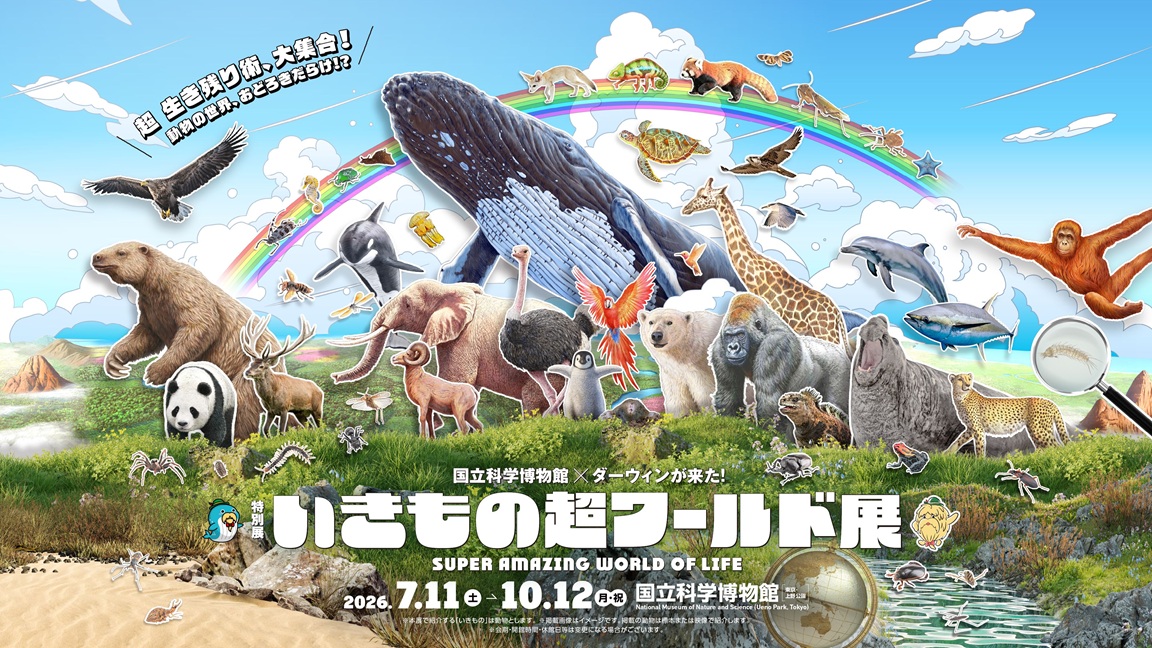
A collection of amazing survival techniques! The animal world is full of surprises!? Special exhibition “The Super World of Living Things: National Museum of Nature and Science x Darwin’s Coming!” is confirmed!

National Museum of Nature and Science

Date: July 11th (Sat) – October 12th (Monday/holiday), 2026
Venue: National Museum of Nature and Science (Ueno Park, Tokyo)

The National Museum of Nature and Science, NHK, and NHK Promotions will be holding a special exhibition themed on "Survival Strategies of Living Things," titled "The Super World Exhibition of Living Things: National Museum of Nature and Science x Darwin's Coming!" from July 11th (Sat) to October 12th (Mon/Holiday), 2026.
From the Earth's formation to the present day, the Earth's environment has changed dramatically. Living things that have adapted to this diverse and ever-changing environment have nurtured the next generation, building a long history of life's evolution.
This exhibition broadly introduces the adaptive evolution, survival strategies, and acquired traits and functions of such creatures, primarily focusing on animals. In collaboration with NHK's nature program "Darwin Comes to Town!", the exhibition utilizes specimens and materials from the National Museum of Nature and Science, research findings, and numerous videos filmed by NHK to explore the environmental adaptations and survival strategies of animals, organized by topic.
Furthermore, under the supervision of researchers from the National Museum of Nature and Science specializing in vertebrates, invertebrates, insects, and paleontology, this exhibition clearly introduces the amazing world of "survival strategies of living things."

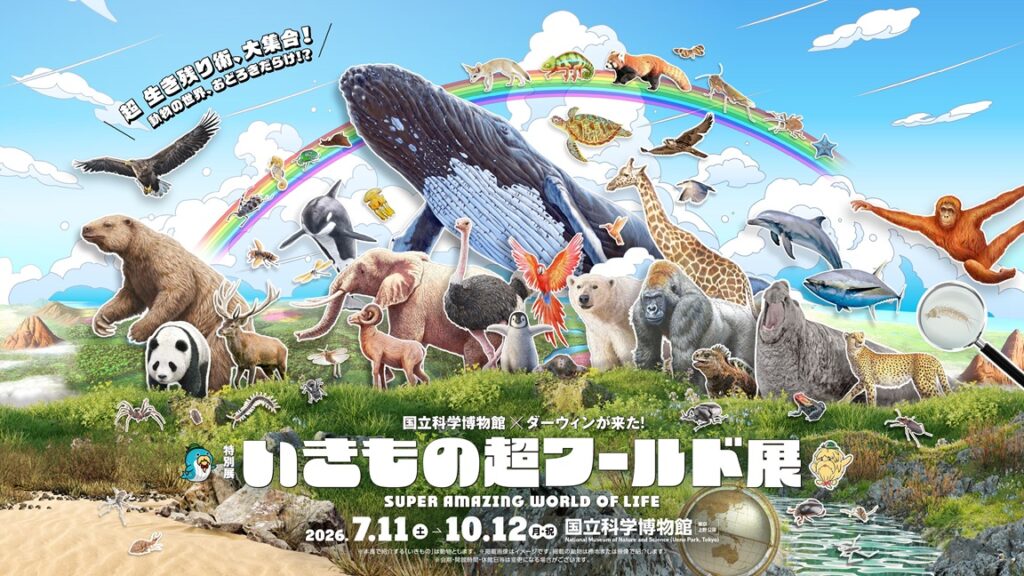
We are pleased to announce that the main visual for this exhibition has been completed. The visual features a large gathering of various creatures.

The special exhibition "The Super World of Living Things: National Museum of Nature and Science x Darwin's Coming!" opens this summer in July. Please look forward to it!

<Exhibition composition>
Learn with specimens and videos! The more you know, the more fascinating it becomes! The "survival strategies" of living creatures.
This exhibition showcases the amazing and inspiring world of living creatures, using specimens and the latest research findings from the National Museum of Nature and Science, as well as breathtaking footage of animals surviving in the wild that has been filmed by NHK's "Darwin Comes to Town!".

[CHAPTER 1] The Five Senses that Different Living Things Have
The five senses: sight (seeing), touch (touching), hearing (hearing), smell (smelling), and taste (tasting).
These are crucial sensors for survival! Which sensors are highly refined in different creatures, and what surprises and strategies do they employ?

[CHAPTER 2] How living things change your "energy replenishment"
Energy replenishment is absolutely essential for survival. The strategies for achieving this are a treasure trove of diversity, and the more you learn about them, the more fascinating they become. Let's take a look at the diverse strategies used to acquire energy sources (animals and plants) and how they are absorbed into the body.

[CHAPTER 3] The Challenges of Living Things: How to Adapt to Size
The body sizes of living creatures vary greatly. Some creatures that are small now were once large, and the largest animals on Earth can be found in the ocean. If you look closely at the sandy beach, you'll find countless creatures too small to see with the naked eye. Amazing strategies and adaptations can be seen in their body sizes.

[CHAPTER 4] Different Forms of "Movement" in Living Things
Most living things live by moving, but the means of movement and the physical structures they employ are incredibly diverse. This is to adapt to their habitat and to develop survival strategies. But did you know that some creatures don't move at all?! Let's take a look at some amazing survival techniques.

[CHAPTER 5] The Significance of "Groups" as Learned from Living Things
To gain an advantage in various situations, most living things spend their entire lives alone, making it an important survival strategy. On the other hand, there are also many living things that have survived by deliberately "grouping." What does it mean to "group"? What does it mean to "not group"? Let's explore the significance and true meaning of these two approaches.

[CHAPTER 6] The "Baton of Life" Woven by Living Things
Living things pass on the "baton of life" to the next generation through repeated cycles of encounter, nurturing, and departure. This is the foundation of all living things. Let's look at the surprising and moving strategies and adaptations we see in each of these scenes.

*The "living things" featured in this exhibition are animals.
*The images on the flyer are for illustrative purposes only. The animals shown will be presented as specimens or in videos.

<Original character for this exhibition>
"Kujira-jii" is born!

Name: Kujiraji
The exhibition's original character, "Kujira-jii," was created in collaboration with Hige-jii from the TV show "Darwin's Coming!".
This section connects the highlights of the specimens, research, and videos, highlighting the surprising points.

<Exhibition Navigator>
Masaki Aiba has been chosen as the navigator for this exhibition!

Masaki Aiba, who is active in many fields as an actor and talent and appears as the navigator for NHK's nature program "Darwin Comes!", will guide you through the amazing world of living creatures.

[Event Overview]
Name: Special Exhibition "The Super World of Living Things: National Museum of Nature and Science x Darwin's Coming!"
Date: July 11th (Sat) – October 12th (Monday/holiday), 2026
Venue: National Museum of Nature and Science [Ueno Park, Tokyo]
(7-20 Ueno Park, Taito-ku, Tokyo 110-8718)
Organizers: National Museum of Nature and Science, NHK, NHK Promotions
Production cooperation: NHK Enterprises
Official website: https://ikimonoworld.jp

Supervision
Yuko Tajima, Senior Researcher, Vertebrate Research Group, Department of Zoology, National Museum of Nature and Science
Hiroshi Namikawa Research Director, Marine Invertebrate Research Group, Zoological Research Department, National Museum of Nature and Science
Tatsuya Ide, Senior Researcher, Terrestrial Invertebrate Research Group, Department of Zoology, National Museum of Nature and Science
Takanobu Hihichi National Museum of Nature and Science, Life History Research Department, Evolutionary Paleontology Research Group, Research Director

[Related Program Information]

"Darwin's Coming!" NHK General TV / Every Sunday at 7:30 PM
From remote wilderness to familiar city streets, this NHK nature program closely follows wildlife around the world. Utilizing the latest equipment to its fullest, it presents stories of the great outdoors filled with wonder and emotion through exclusive footage. 2026 marks the 20th anniversary of its broadcast!
The program has aired over 900 times and covered more than 70 countries and regions. The reporting team has achieved over 160 "world firsts"! Their findings have also been published in numerous scientific papers.

[From the press release of the Special Exhibition "The Super World of Living Things: National Museum of Nature and Science x Darwin's Coming!" Secretariat]


View other exhibition information

[National Museum of Nature and Science] Announcement of Special Exhibition: “Satoshi Kako’s Science Picture Books” Commemorating the 100th Anniversary of His Birth

National Museum of Nature and Science

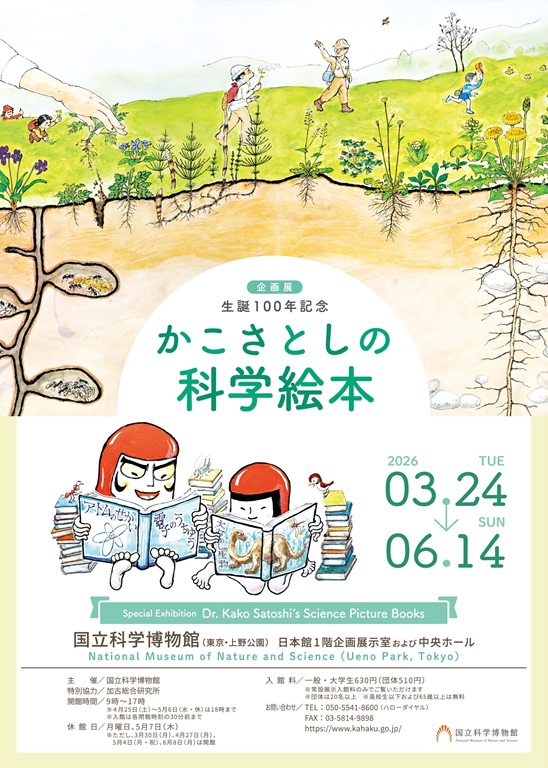
The National Museum of Nature and Science will hold a special exhibition, "Satoshi Kako's Science Picture Books: Celebrating the 100th Anniversary of His Birth," from Tuesday, March 24, 2026 to Sunday, June 14, 2026, as detailed below. [For more information, please visit: https://www.kahaku.go.jp/tenji-event/nid00001839.html ]

Poster visual for "Satoshi Kako's Science Picture Books," commemorating the 100th anniversary of his birth.

Satoshi Kako (1926-2018) was a picture book author who debuted in 1959 with "The Dam Builders" and has since published over 600 books. His picture books spanned a wide range of genres, including humorous works such as "The Crow's Bakery," as well as many science picture books, including "The River." These works can be considered pioneers of science communication and contributed to the development of science education.

This exhibition commemorates the 100th anniversary of Satoshi Kako's birth and showcases his major science picture books, along with his passionate beliefs in science education and his insatiable curiosity for natural science, all presented with original illustrations. Please enjoy the world of science picture books as seen through the eyes of a researcher, as only the National Museum of Nature and Science can.
Project Overview

Special Exhibition: 100th Anniversary of Birth – "Satoshi Kako's Science Picture Books"

[Venue] National Museum of Nature and Science (Ueno Park, Tokyo), Japan Gallery, 1st Floor, Special Exhibition Room and Central Hall

[Event Period] March 24, 2026 (Tue) – June 14, 2026 (Sun)

[Opening Hours] 9:00 AM – 5:00 PM
*From April 25th (Sat) to May 6th (Wed/Holiday), we will be open until 6 PM.
*Entry is permitted until 30 minutes before each closing time.

[Closed days] Mondays, Thursday, May 7th
*However, the museum will be open on March 30th (Mon), April 27th (Mon), May 4th (Mon/National Holiday), and June 8th (Mon).

[Admission Fee] General public and university students: 630 yen (510 yen for groups), high school students and younger, and those 65 years and older: Free
*This exhibition can be viewed with the regular admission fee only. *Group rate applies to groups of 20 or more.
*For details on admission procedures and other information, please visit our website.
https://www.kahaku.go.jp/

[Sponsor] National Museum of Nature and Science

[Special Cooperation] Kako Research Institute

[Exhibition Overview] See attached exhibition flyer.

Supervisor of this exhibition

Senior Researcher, Fungi and Algae Research Group, Department of Botany, National Museum of Nature and Science
Taiju Kitayama

His specialty is phycology. To unravel the mysteries of the seaweed fauna along the Japanese coast, where an unparalleled diversity of warm and cold currents flows, he collects seaweed by free diving and dredge from Hokkaido in the north to the Ogasawara Islands in the south. Recently, he discovered the brackish water alga Kanagawa Aonori, a new species found in Japan, on Chichijima Island and is continuing his research. He also conducts research on freshwater algae in Tokyo, and in 2024, he reported a new species of red alga Kitanomaru Mozuku from Kitanomaru Park in the outer gardens of the Imperial Palace. The museum's permanent exhibitions include a systemic plaza, Japanese seaweed, Earth history navigator, and Yoshio Tanaka projection mapping.

Kako Research Institute Representative: Mari Suzuki
She is the representative of Kako Research Institute and the eldest daughter of Satoshi Kako. She has worked at Kako Research Institute since 2003, supporting her father's work. Currently, she gives lectures and engages in other activities with her husband.

[Agency for Cultural Affairs] Press Release


View other exhibition information